
Why aren't more Billionaires Doing What Mackenzie Scott has done?
Isn't this a new model of philanthropy worth emulating?

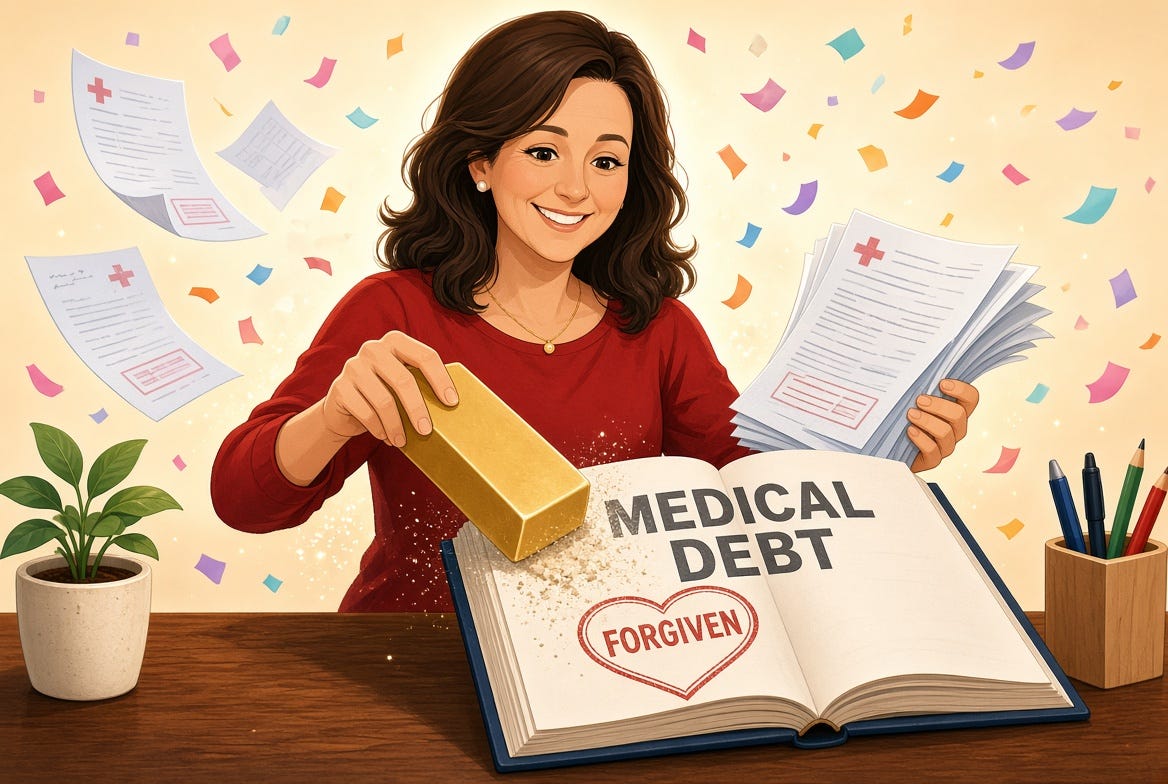
MacKenzie Scott, bless her, has shown in quite spectacular fashion what can happen when serious wealth is put to good use for ordinary people.
Through gifts totalling more than $100 million to Undue Medical Debt - a U.S. non-profit charity that buys large portfolios of unpaid, past-due medical debt for pennies on the dollar, and forgives it, she has helped wipe out over $40 billion in medical bills across all fifty American states. Through this move alone, millions of Americans families have been freed from debts that once threatened their credit ratings, their homes and their peace of mind.
The method is simple and very effective. Hospitals and other healthcare providers (such as physician groups) will sell old, uncollectible patient accounts in bulk at a fraction of their supposed value. Undue Medical Debt then steps in with donated money, and buys those portfolios for pennies on the dollar. It cancels the debt completely. No strings attached, no further payments, the whole debt is wiped off. So, to give an example, a £10 donation gift can erase roughly a £1,000 of medical debt. No collection calls. No lasting mark on a credit record. Just complete debt relief.
MacKenzie Scott did this after selling a large share of her Amazon holdings. She has already given away more than $26 billion in total, often with little fanfare and few conditions. Her approach is to treat large amounts of wealth as a temporary responsibility rather than a permanent entitlement. And that approach stands in stark contrast to the philanthropy of many wealthy people.
Because most of the world’s richest people still prefer to hold on to their burgeoning fortunes. The prevailing philosophy, i think, appears to be if you have $1 Billion you should aim to grow it into $3 Billion or $5 Billion. If you have $10, aim for 20 or 30 and so on. And so, they fund foundations that carry their names, invest in prestige (and at times vanity) projects, or simply accumulate further and further.
In the US, Medical debt remains a leading cause of bankruptcy (Himmelstein, D. U., Lawless, R. M., Thorne, D., Foohey, P., & Woolhandler, S. (2019). Medical Bankruptcy: Still Common Despite the Affordable Care Act. American Journal of Public Health, 109(3), 431–433. https://doi.org/10.2105/AJPH.2018.304901
(Also available via PMC: https://pmc.ncbi.nlm.nih.gov/articles/PMC6366487/)). People who have already paid for insurance still face bills they cannot meet after an accident, after a birth or after a chronic illness. The gap between what the wealthy can afford to ignore and what many ordinary people must endure grows wider every year. By comparison, this kind of inequality is similar to that which other Activists like Gary Stevenson in the UK has been flagging up. It's just arguablymore urgent.
Egalitarianism is not a soft ideal. It is the practical recognition that a society functions better when the worst burdens do not fall on those least able to carry them. When there's proportionality and fairness. MacKenzie Scott’s gifts prove that large private fortunes can shrink those burdens at remarkable scale. And quickly. A handful of other wealthy individuals have begun to follow her lead, but the numbers remain tiny beside the fortunes that sit idle.
If more billionaires adopted the same direct, efficient model, the results would be immediate. So let's put medical debt aside and focus just on normal household debt of millions of people. Taking a similar approach as MacKenzie Scott would mean debt that currently ruins credit scores and forces impossible choices could disappear for millions more. Instantly.
Please don't take my word for it. Find out for yourself. Ask anyone who owes $5,000 or $10,000 or $50,000, what writing off 90% of that debt would mean to them? It means parents would suddenly have resources to buy healthier food. It means many more parents would have more time to spend with their children - instead of juggling 2 or 3 jobs to make ends meet. It means there would now be time to go to the museum, to attend entertainment events, to attend a countryside market, to attend the children's school sporting events. It means there would now be money for private tuition - where previously there was no budget for such. Stress levels across communities would drop instantly and peoples healths would improve significantly, so indirectly the medical facilities themselves would also be less stretched. Debt relief makes a world of a difference in people's lives.
The alternative, with respect to medical debt is that there will be continued concentration of resources in fewer hands while basic medical security stays out of reach for many. The alternative in relation to ordinary household debt is that growing inequality continues to get wider and wider.
Scott has already demonstrated what is possible. The question is no longer whether this approach works, but thar what is stopping others with similar fortunes from using those fortunes in the same way.